Sadu: Digital Interpretation
سدو: إعادة تأويل رقمية
An ongoing visual research project exploring Sadu patterns through questions of mobility, translation, and transformation across time, place, and media.
2018 – 2025
My father's village, Jiroud, located in the Qalamoun region at the edge of the Syrian Desert, has long been connected to settled Bedouin communities. I remember that almost every household there owned a piece featuring Sadu patterns.
Sadu is a traditional handwoven textile created by nomadic and Bedouin women across regions such as the Arabian Peninsula and the Syrian Desert (Badiyat al-Sham), using goat hair, sheep wool, or camel hair. Its geometric patterns carry cultural meanings related to nature, nomadic life, and tribal symbols.
In the early twentieth century, the rise of modern nation-states and political borders transformed Bedouin life across the region. Processes of settlement gradually replaced nomadic movement, restricting mobility and impacting many traditions, including Sadu itself.
My interest in Sadu lies in its relationship to movement: between places, across time, between traditional and digital forms, and between lived experience and memory.
Tracing Series
3D Lenticular Prints
2021 - 2025

Untitled
3D Lenticular print, 40 x 80 cm 2025

What happens when a traditionally two-dimensional textile language is given three-dimensional depth?
Through 3D lenticular printing, Sadu patterns shift as the viewer moves, appearing, disappearing, and reforming with every change of perspective.
Adding a third dimension also introduces a fourth: time, bringing traditional patterns and contemporary digital processes into the same visual space.
Can changing perspectives become a way of thinking about mobility, settlement, and borders?

Untitled
3D lenticular print, diptych, 80 × 80 cm and 20 × 80 cm, 2025


Formation
3D Lenticular print, 80 x 80 cm 2021

Translation Series
Digital prints viewed through anaglyph 3D glasses (red and blue lenses)
2021


Weaving leaves room for variation. No two lines are exactly alike, and small irregularities become traces of the hand that made them.
These works explore the relationship between the woven unit of Sadu and the pixel of the digital image. Through anaglyph 3D processes, patterns are fragmented and reconstructed in depth, allowing moments of disruption to emerge within an otherwise ordered system.
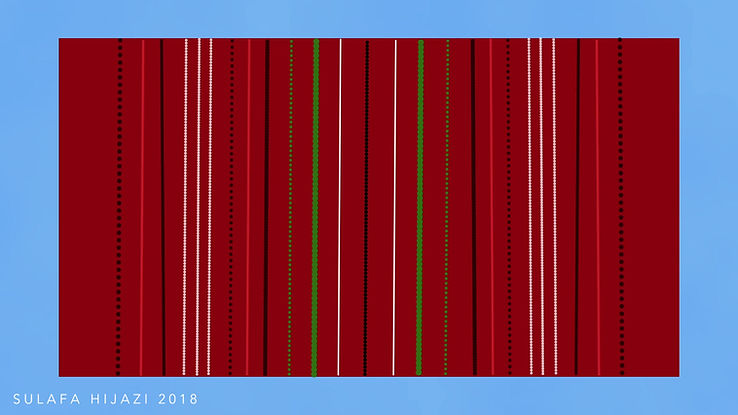
Full HD Rug
Video, 50 sec, 2018
Audio frequencies generate wave-like structures that gradually develop into patterns.
Patterns reproduce, multiply, and transform, creating a rhythm that oscillates between technological process and ritual gesture.
As repetition intensifies, the visual system becomes overloaded. The image fragments, breaks down, and eventually collapses.
What happens to cultural symbols when they circulate through digital systems? How do patterns carry meaning as they move between craft, technology, memory, and code?